
Walk a Clearwater Street by Address
The most reliable street-by-street search begins with land, not a presumed resident. Pinellas County Property Appraiser Quick Search accepts a street name without a number, so it can return parcels along a corridor. Each result may identify the site address, parcel key, tax district, land use, short legal description, last deed, and map. Ownership is public evidence. Occupancy is a separate claim that needs support from a homestead indicator, a public voter record, or a dated directory entry.
Keep the same parcel identity as the search moves between agencies. Clearwater permits and code cases use street addresses, while Clerk deeds rely on names, recording data, and legal descriptions. This sequence keeps two similar addresses or owners from being merged.
- Enter the street name in PCPA Quick Search. Add a house number only after the broad street result confirms the official spelling.
- Open the parcel and save its STRAP, situs address, legal description, current owner, tax district, and last recorded deed.
- Use the Parcel Viewer to click the lots on either side and across the road. Do not treat an owner's mailing address as the location of the land.
- Follow the book/page link into Clerk Official Records, then match grantor, grantee, legal description, and recording date.
- Add lawful voter-extract evidence and Polk criss-cross entries only when the research question truly concerns registered or historical occupants.
This is the core Clearwater street directory workflow: address to parcel, parcel to deed, and dated occupant evidence only where a separate record supports it.
Search Clearwater Property Fields
PCPA is the strongest first stop because its search modes bridge ordinary addresses and recorded documents. Official guidance says that less information often produces better results and that street suffixes should be abbreviated. The owner field accepts a surname, and the paired official-record book/page field can reopen a known parcel. Tangible-property searches add business, category, ZIP, and tax-district filters.
| Search field | Useful input | Clearwater result |
|---|---|---|
| Address or Street Name | Number plus street, or street alone | Parcel rows along a street |
| Owner | Business or surname | Deeded-owner matches |
| Parcel ID | 18-digit STRAP | One stable parcel record |
| Sub/Condo | Subdivision or condominium | Grouped parcel browse |
| OR Bk/Pg | Book and page pair | Parcel plus Clerk document link |
| Tax District | CW, CWD, or CWDO | Clearwater jurisdiction check |
The PCPA help screen documents the address syntax used for Clearwater parcel searches.
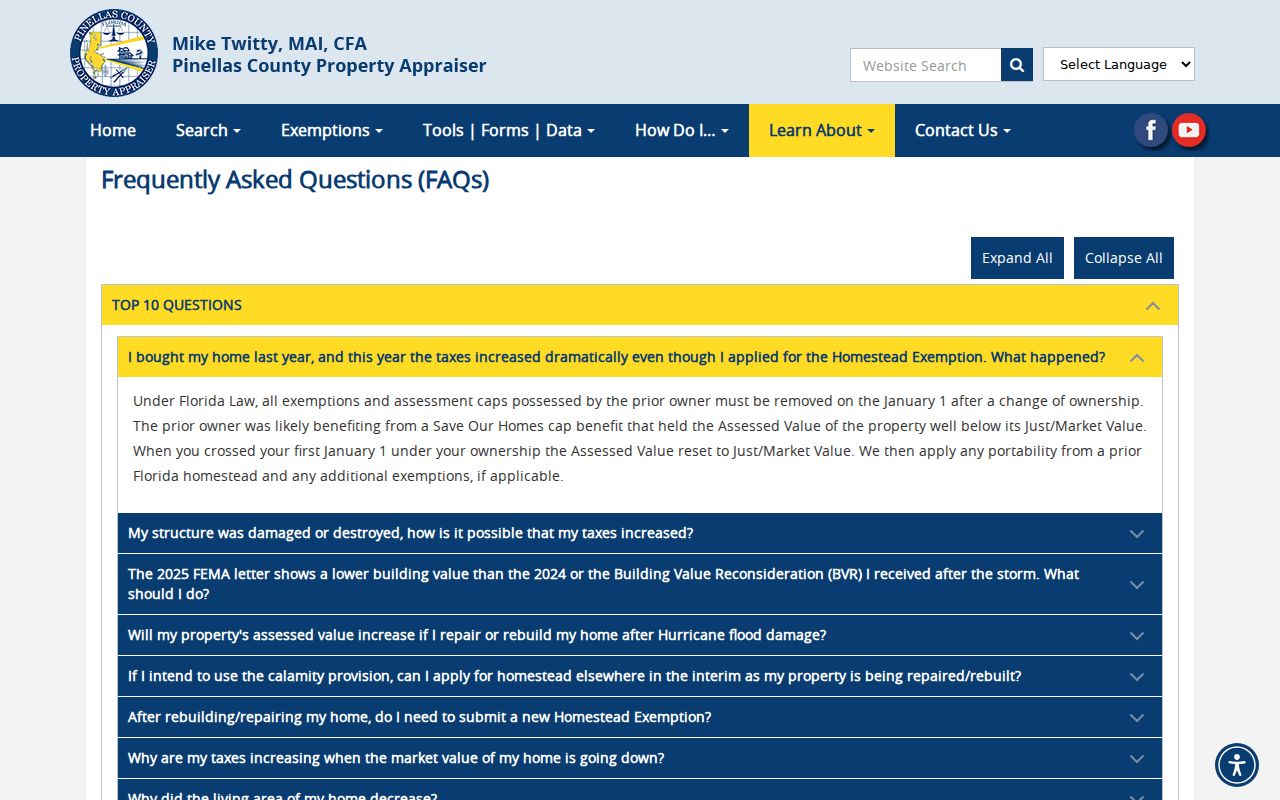
The result can be printed or exported. For deeper work, PCPA also publishes owner, owner-mail, legal, and other tables in CSV, JSON, Excel, and XML formats. A historical assessment snapshot can be requested by giving the STRAP and tax year.
Clearwater Street Names Need Care
One local search form matters more than it seems. PCPA tells Clearwater users to enter Martin Luther King Jr Ave; other Pinellas municipalities use different forms. Start broad when a suffix or directional may have changed. Then use the STRAP and legal description to hold the identity steady. No authoritative citywide street-renumbering year was found, so a date should never be guessed.
- Parcel
- A mapped unit of land carried as one assessment record.
- Situs address
- The physical location of the land, distinct from the owner's mailing address.
- Plat
- A recorded map that identifies a subdivision, lots, blocks, streets, and easements.
- Criss-cross directory
- A historical directory section arranged by street and house number instead of surname.
These terms keep a street directory precise. The situs finds land, the STRAP joins databases, and the plat or legal description carries the parcel into deeds even when address text varies.
Map Clearwater Parcels in Sequence
The PCPA Parcel Viewer is built around parcels, not people. Search by owner, address, or parcel ID, center the result, then click nearby parcels. A click outside the red selected boundary changes the detail panel to that lot. Filled Parcel and aerial styles help separate lots; the sales-year control highlights transfers; Measure reports distance or area.
The official parcel-viewer screen shows why map clicks work better than guessing which homes count as adjacent.
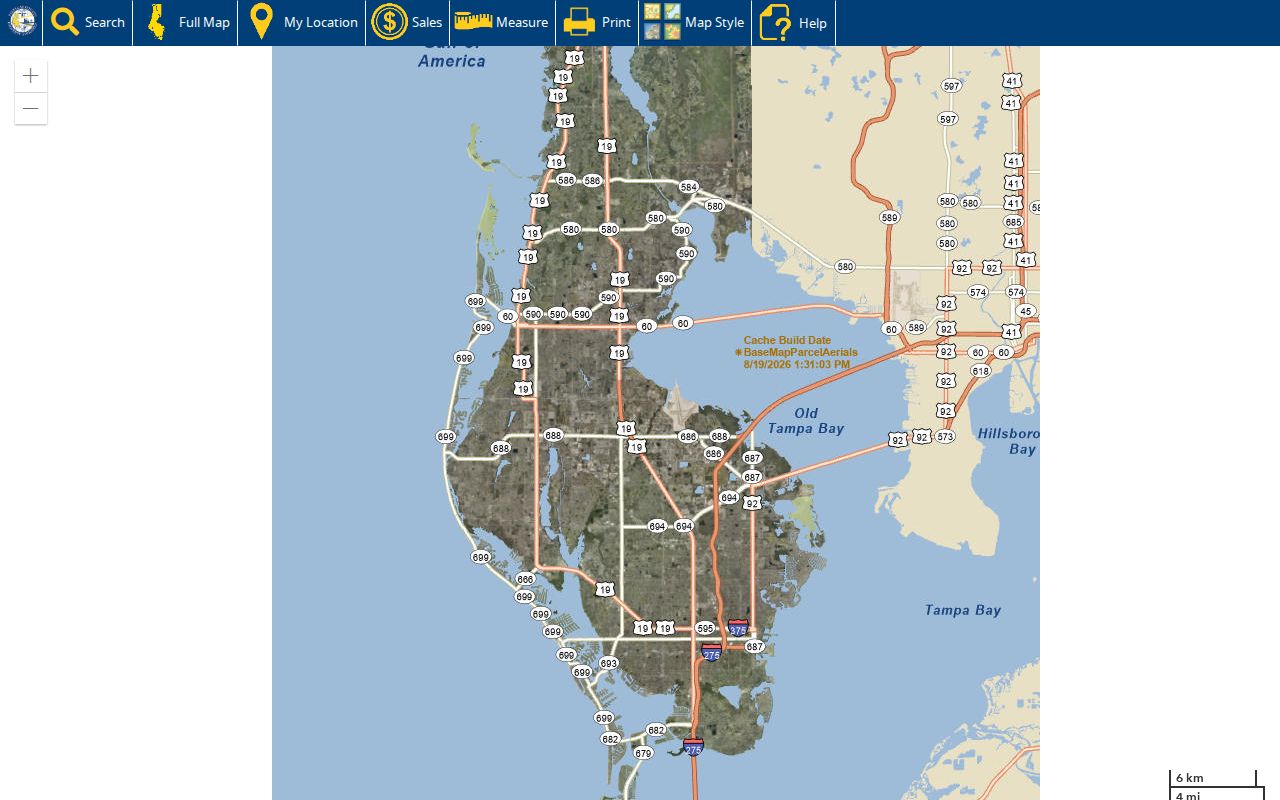
Use each clicked parcel's own situs and legal data. There is no verified radius-owner export, and the viewer does not claim to identify residents.
Clearwater Street Directory Record Layers
No single roll answers who lives along a Clearwater street. Combine only the layers that fit the task, and preserve the date of each result. A deed proves a transaction, a permit documents work, and a directory shows a listed occupant in its publication year.
| Record Set | Keeper | What It Shows | Access |
|---|---|---|---|
| Assessment roll | Pinellas Property Appraiser | Owner, situs and mail, exemption, legal, deed links | Free search and export |
| Parcel GIS | PCPA | Lot geometry, nearby parcels, sales and map styles | Free viewer |
| Deeds and plats | Pinellas Clerk | Parties, transaction, instrument, legal description | Free index; copies available |
| Voter records | Supervisor or state extract | Nonsuppressed registered voters at addresses | Public-record request rules apply |
| Permits and planning | Clearwater Accela | Applicants, work, status, inspections, attachments | Free, no-login search |
| Polk street sections | Clearwater Library | Listed occupants and businesses by house number | Digitized selection and on-site shelf |
The legal bridge is address to STRAP or legal description to deed book/page. The historical bridge is a modern parcel to a directory street heading and house number. A mailing address belongs to correspondence and may be far from Clearwater.
Follow Clearwater Ownership into Deeds
PCPA Sales History provides book/page links that jump from a parcel to the Pinellas Clerk Official Records system. That link is the best way around a deed index that is based chiefly on party names and recording data rather than occupancy. Capture the grantor, the seller; the grantee, the buyer; document number; date; and exact legal description.
To move backward, search the seller as an earlier grantee and confirm the same legal description. When the web index becomes unreliable, Recording Services at 315 Court Street, Room 150, has staff and public access. Call 727-464-4876 or email recording@pinellascounty.org with a book/page, document number, party, and approximate year. Ask whether an informational or certified copy fits the need and request a current fee quote.
Older land research may cross a county line in time. Pinellas County was formed from Hillsborough County in 1912, so earlier Clearwater records may be in predecessor or transferred books.
Add Clearwater Permits by Address
Clearwater's permit research instructions direct users to Accela for building, planning, business-tax, and related records. No account is needed to search. Choose the proper tab and try street number and name with few other fields. Search-by-contact can locate an applicant, architect, representative, or contractor.
The city's permit-search instructions show the address-based path and the kinds of case detail available.
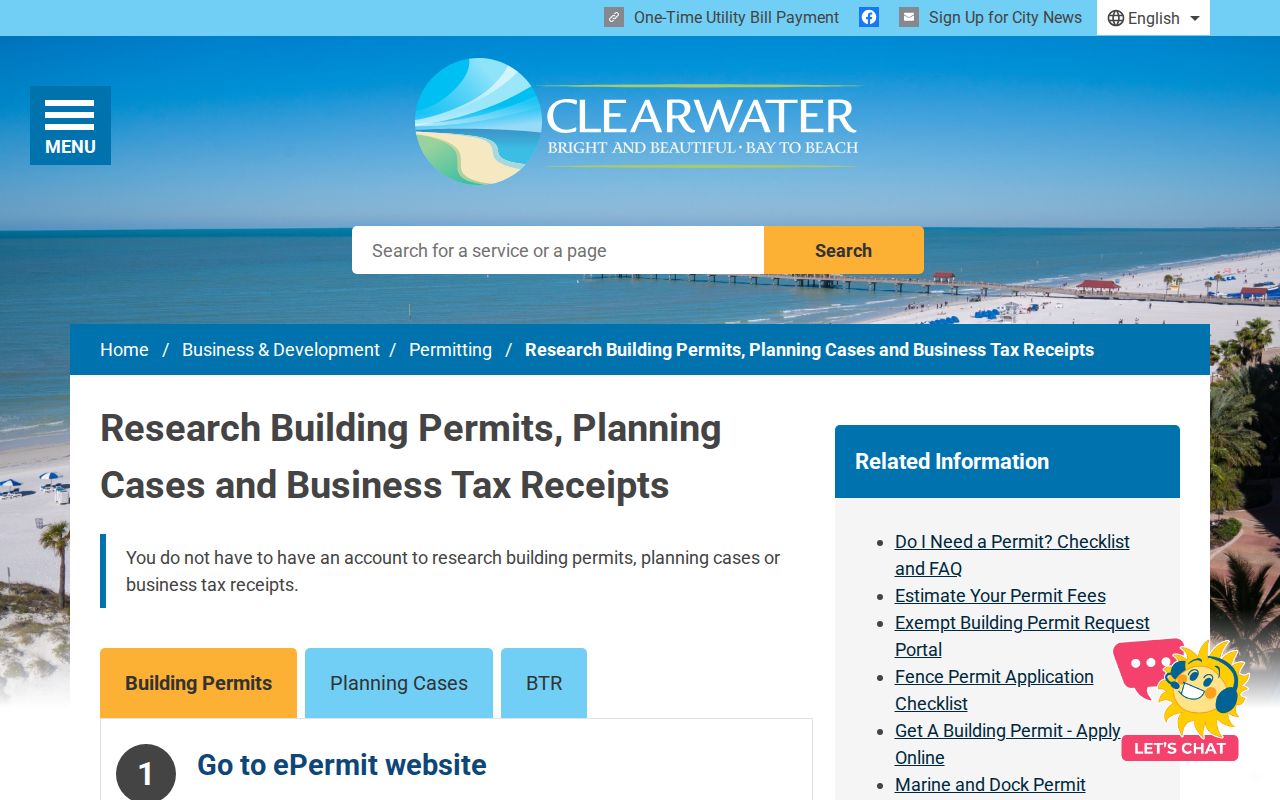
Record Info can include case details, processing status, related records, and attachments. Reports may produce a Case Summary PDF. Permits help date work and may name parties, but they do not prove continuous residence.
Clearwater Code Cases Join Parcels
The Clearwater Code Compliance Dashboard accepts an address or map location. In April 2025 the city began matching confirmed-violation addresses to PCPA parcel data and changed case-resolution measurement to business days. That makes parcel comparison stronger without turning the case list into an occupant directory.
The dashboard image shows the official address-based compliance view used beside property records.
Public case material may contain sensitive details. Use the status and parcel link for civic or property research, and avoid repeating personal information that is not needed.
Clearwater Voters Are a Partial Layer
Florida voter information can include name, residence address, date of birth, party, status, registration data, and election-participation history. Ballot choices are never shown. Social Security numbers, driver-license or state-ID numbers, and registration source remain confidential; signatures may be viewed but not copied. Protected voters can have identifying or location data withheld.
The individual Pinellas Supervisor of Elections lookup verifies one registration and is not a browse-by-street tool. For a lawful street project, request a described public extract and filter address fields while preserving suppressed rows. A missing name may mean no registration, another county, inactivity, a spelling mismatch, or protection. It is not proof that a person moved.
Note: Voter history shows participation in an election, never the candidate or measure selected on the ballot.
Check Clearwater City Limits
A Clearwater postal address does not prove that a parcel sits inside the city. ZIP delivery areas cross municipal lines, and Pinellas County contains enclaves plus agreements to annex. PCPA Current Tax District codes CW, CWD, or CWDO are the local jurisdiction check. The city annexation GIS adds a map of unincorporated properties, enclaves, and service areas.
This distinction decides which permit or code office should hold an address record. It also explains why two close parcels can have different city services. The street directory should retain the postal address and jurisdiction as separate facts.
Barrier-island condominiums need extra care. A unit-level parcel ID may differ from the association's address, and the deeded owner's mail may lead to another state. Postwar inland subdivisions tend to have denser annual directory coverage and later permits, while old downtown and North Greenwood addresses benefit more from early Polk books, plats, and newspaper research. Along US 19, business records may be more useful than a household inference. These built eras shape which Clearwater record layer is strongest, but none changes the need to distinguish ownership from occupancy.
Key check. Compare the situs address with the Current Tax District before assuming Clearwater is the correct municipal custodian.
Read Older Clearwater Streets
Historical Polk directories reverse the modern owner-first approach. Their criss-cross sections arrange a street by house number and may name a listed occupant or business. Clearwater Library has a digitized selection from 1914 through 1979, while the physical shelf may be broader. Geographic titles change across the run, so check nearby-city sections and the street index before treating an absence as a move.
For full collection detail, use the Clearwater city directory page. On a street project, record the volume title, year, publisher, section, and page. OCR can misread names and numbers. The Clearwater Sun, library maps, and on-site staff can bridge gaps when a volume is missing.
Limits of Clearwater Street Records
A Clearwater street directory cannot provide a complete, current household roster. Property records name deeded owners, not every occupant. Deeds document legal events. Permits name project roles. Voter files omit nonvoters and protected people. Old Polk entries reflect only the date and scope of one volume. Renters and unlisted household members may never appear in any of these sources.
Driver-record personal data is restricted under federal law, and utility customer or delivery data does not become a public street list. Address Confidentiality Program participants and qualifying high-risk professionals may have location details suppressed. Keep those omissions intact. For one named person's modern verification, shift to the distinct Clearwater resident lookup workflow and require more than one independent match.
Lawful use. Use Clearwater address records only for lawful personal research, civic transparency, property questions, or family history. Never use them to stalk, harass, intimidate, or harm anyone.